
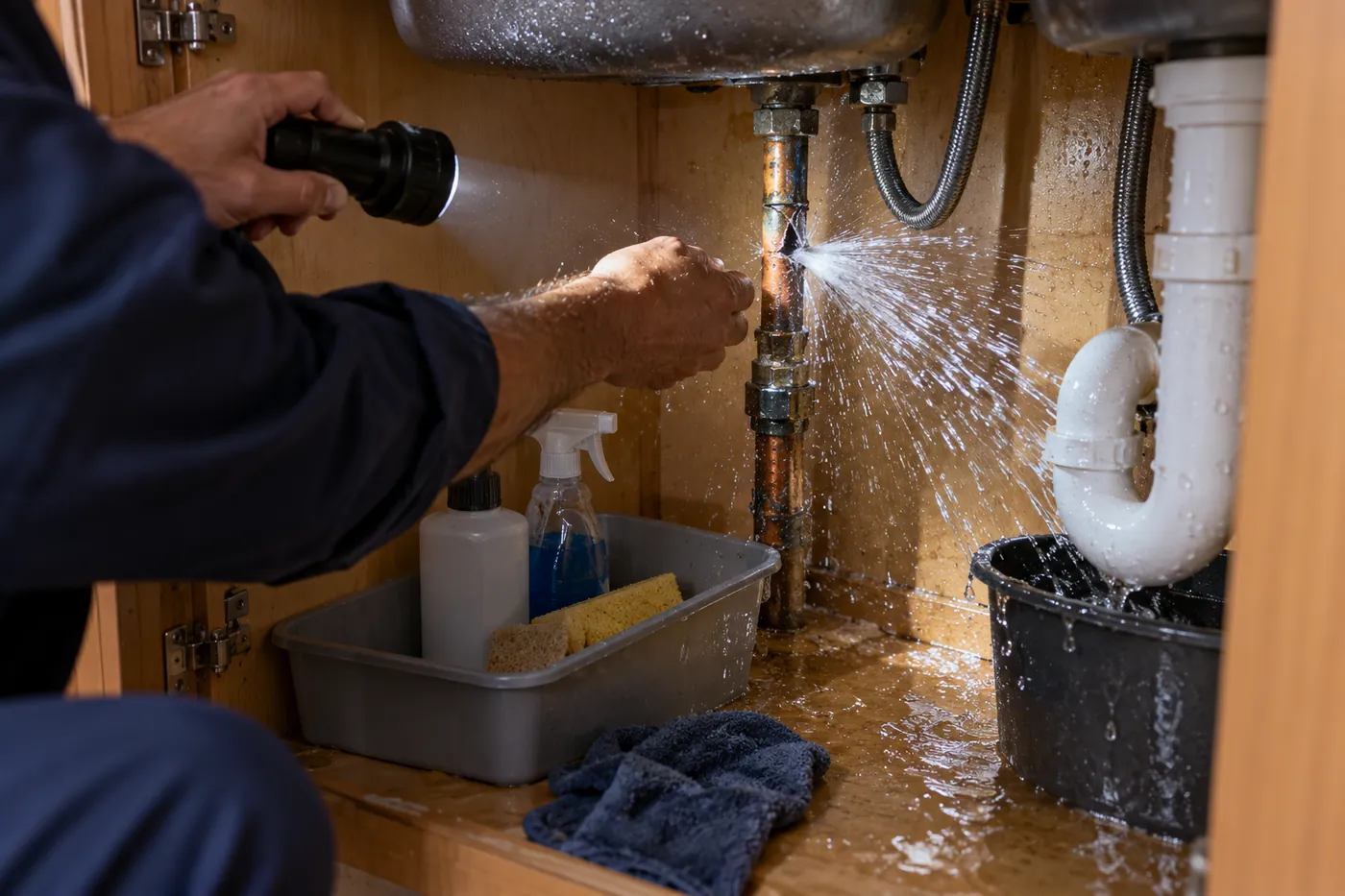
What should you do when a pipe bursts?
Move people away from the water, close the nearest fixture valve if it is safe, and then shut off the main water valve. Keep away from wet electrical equipment and sagging ceilings. Take photos, protect valuables without entering danger, and call for plumbing help before cutting into walls or starting cleanup.
Get people away from the water, especially if it reaches outlets, appliances, or a ceiling below. Close the nearest fixture valve if you know it, then close the main shutoff. Turn off water-heating equipment only if instructions and conditions make it safe, and never touch electrical equipment while standing in water.
Open a cold faucet at a safe sink to reduce pressure after the supply is off. Move valuables, place buckets under controlled drips, and take photos before cleanup. Do not cut into walls or ceilings to chase the pipe.
If water is near electrical panels, do not enter the area. Call emergency services if someone is trapped or there is an immediate electrical or structural danger. A plumber can locate the break, stop the flow, and check for wet insulation or hidden damage.
Is a leaking water heater an emergency?
A water heater leak becomes urgent when water is spreading, the tank seam is leaking, hot water is escaping, or the leak is near electrical equipment. Close the cold-water shutoff if it is safe and dry. If you smell gas, leave the building and call PG&E or 911 from outside first.
Water around a tank can come from a loose connection, temperature and pressure relief valve, drain valve, tank seam, or condensation. A small fitting leak may grow quickly, while water from the bottom of the tank can signal internal failure.
Close the cold-water shutoff above the heater if it is reachable and dry. If the leak is from the gas line or you smell gas, leave the building and call PG&E or 911 from outside first. Do not relight a pilot, adjust gas controls, or work on electrical connections.
Keep clear of hot water and wet flooring. If the leak stops and no other damage is present, a scheduled visit may be possible, but a spreading leak or full tank should be handled urgently. Note the leak location, water color, and whether the tank is making popping sounds.
What plumbing problems can wait?
A slow drain, small faucet drip, running toilet, or minor leak can often wait for a scheduled visit when water is contained and no health or structural risk is growing. Close the local valve when possible, use a pan under the drip, and call sooner if the leak spreads or more fixtures are affected.
Some problems are disruptive but can wait for a planned visit when water is contained and no health or structural risk is growing. Examples include a slow drain that still flows, a faucet drip that can be shut off, a toilet that runs but does not overflow, or low pressure at one fixture.
Use the local shutoff when possible and place a pan under a drip. Do not pour chemical drain cleaner into a blocked line if you may need to open the trap later. Keep children and pets away from standing water, and watch ceilings, cabinets, and flooring for changes.
Call sooner if a contained leak spreads, a drain backs up, water turns brown, several fixtures lose pressure, or a ceiling begins to bulge. Write down which fixtures are affected, when the problem started, and what valves you closed.
What should you do if sewage backs up or a toilet overflows?
Keep people and pets away from sewage, stop using nearby fixtures, and shut off the toilet valve or main water valve. Do not keep flushing or use household cleaners on contaminated water. An active backup can spread through more drains, so call for plumbing help and record where the water appears.
Sewage backup is an urgent health problem. Keep people and pets away from the water, avoid contact, and do not run faucets, flush toilets, or use appliances connected to the affected drain until the source is controlled.
An overflowing toilet may be stopped by turning the small shutoff valve clockwise. If the valve is stuck, close the main water shutoff. Remove the tank lid only if you can do so without touching contaminated water, and do not keep flushing to test it.
Use gloves and eye protection only for moving clean items away from the area, not for entering sewage. Do not mix bleach with other cleaners. Record where the backup appears, whether other drains are slow, and whether the cleanout is accessible.
What if there is no water or you smell gas?
No water throughout a building may come from a closed valve, broken supply line, failed pressure regulator, or utility issue. Check the main valve without forcing it. For any gas smell, leave the building immediately and call PG&E or 911 from outside first. Never search for the leak or perform gas work yourself.
No water throughout the building can come from a closed main valve, supply line break, failed pressure regulator, or utility issue. Check whether nearby fixtures are affected and confirm the main valve is open, but do not force a stuck valve or dig for a buried line.
Gas odor is different from a water problem. Leave the building immediately, avoid switches, flames, and phones inside, then call PG&E or 911 from outside first. Do not search for the leak or try to shut off gas unless emergency instructions and a safe location make that possible.
After the area is safe, write down whether neighbors also lost water, which fixtures still work, and any recent digging, freeze, or repair. We at ProLine Services can help with emergency plumbing, water heaters, pipe repair, and water lines across the service area.
Which plumbing problems need fast action?
| Problem | Emergency or not | What to do now |
|---|---|---|
| Burst pipe | Emergency | Close the nearest valve and main shutoff if safe |
| Water heater leak | Urgent when spreading or from the tank | Close the cold-water valve and stay clear of hot water |
| Sewage backup | Emergency | Keep people away and stop using nearby fixtures |
| No water throughout the building | Urgent if the cause is unknown | Check the main valve without forcing it |
| Gas smell | Emergency | Leave and call PG&E or 911 from outside first |
| Overflowing toilet | Emergency if the valve will not stop it | Close the toilet valve or main shutoff |
| Slow drain or faucet drip | Often scheduled | Contain the water and monitor for changes |
Questions people ask
Where is the main water shutoff?
It is often near where the main line enters the building, near a water heater, or in a utility area. The valve may be a lever or round handle. Learn its location before a leak happens, and never force a stuck valve. If you cannot find it, call for guidance.
Should I shut off water to a leaking water heater?
If the shutoff above the heater is reachable and the floor is dry, close it carefully. Stay away from hot water, wet electrical parts, and gas controls. If you smell gas, leave immediately and call PG&E or 911 from outside first. Do not relight or adjust the heater yourself.
Can a slow drain wait for a scheduled visit?
Often, if the drain still flows, there is no sewage backup, and water is not damaging cabinets or flooring. Use the fixture lightly, avoid chemical drain cleaner, and watch nearby drains. Call sooner if several fixtures slow down, water rises, or the drain starts backing up.
What should I do before help arrives after sewage backup?
Keep people and pets away, stop using fixtures connected to the affected drain, and move clean belongings only from a dry area. Avoid contact with the water and do not mix cleaners. Note where the backup started, which drains are affected, and whether the main shutoff is closed.